
How to Think About Paris Neighborhoods
Paris is remarkably walkable in its central districts, and the metro system connects nearly every corner of the city efficiently. That said, where you sleep shapes what you see first thing in the morning and last thing at night. A hotel in a lively quartier means you’re already immersed in the city before you’ve had your coffee. A quieter residential area might offer better value but require more planning.
The arrondissements spiral outward from the center in a snail shape. Generally speaking, the lower the number, the more central — and often the more expensive — the location. But character matters as much as geography.
Le Marais (3rd and 4th Arrondissements)
Best for: Culture lovers, LGBTQ+ travelers, history enthusiasts, and those who want to walk everywhere.
Le Marais is consistently one of the most recommended areas for first-timers, and for good reason. It sits at the heart of Paris’s historic core, filled with medieval architecture, art galleries, and some of the city’s best museums — including the Musée Picasso and the Musée Carnavalet. The Place des Vosges, one of the oldest planned squares in Paris, is located here.
The neighborhood is also home to a vibrant Jewish quarter along Rue des Rosiers, a thriving LGBTQ+ scene, and an excellent selection of independent boutiques. On Sundays, when much of Paris closes down, Le Marais remains lively — a significant advantage for weekend visitors.
Accommodation options range from boutique hotels to vacation apartments, typically at a mid-to-high price point due to high demand and central location.
Montmartre (18th Arrondissement)
Best for: Romantics, first-time visitors wanting a picturesque experience, and budget-conscious travelers.
Perched on a hill in northern Paris, Montmartre has a charm that no other neighborhood quite replicates. The winding cobblestone streets, the iconic Sacré-Cœur Basilica visible from much of the city, and the lingering artistic heritage of Picasso, Monet, and Toulouse-Lautrec all contribute to its mythic status.
It’s worth noting that some parts of Montmartre — particularly around Pigalle at the base of the hill — can feel gritty. However, the upper village around the Place du Tertre and the vineyard is genuinely charming. Accommodation here tends to be more affordable than in central Paris, and you’ll find a good mix of small hotels and apartment rentals.
The main trade-off is distance. Montmartre is not as centrally located as Le Marais or Saint-Germain, so expect to rely on the metro for reaching major sights like the Louvre or Notre-Dame.
Saint-Germain-des-Prés (6th Arrondissement)
Best for: Literary travelers, those who appreciate elegance, and visitors who want easy access to both the Left Bank and the Right Bank.
Saint-Germain-des-Prés is synonymous with Parisian intellectual life. The Café de Flore and Les Deux Magots were once regular haunts of Sartre and de Beauvoir, and that legacy still permeates the area. Today, it’s one of the most refined neighborhoods in the city, filled with high-end shops, excellent restaurants, and beautifully maintained Haussmann-era buildings.
Staying here places you within walking distance of the Luxembourg Gardens, the Musée d’Orsay, and Notre-Dame Cathedral. It is, however, among the more expensive areas for accommodation. If budget is a consideration, it may be worth looking at the neighboring 5th arrondissement (the Latin Quarter) as a slightly more affordable alternative with a similar atmosphere.
The Latin Quarter (5th Arrondissement)
Best for: Students, solo travelers, budget-conscious visitors, and those fascinated by academic Paris.
The Latin Quarter takes its name from the medieval tradition of students and scholars speaking Latin in the streets around the Sorbonne University. Today it retains an energetic, youthful feel, with affordable restaurants, independent bookshops, and a density of cafés that rival any neighborhood in the city.
The Panthéon, the Jardin des Plantes, and the Musée de Cluny (dedicated to medieval art) are all located here. Accommodation options include a wide range of budget hotels and hostels, making it one of the most accessible areas for first-timers watching their spending.
The Eiffel Tower Area (7th Arrondissement)
Best for: Travelers who want to wake up with views of Paris’s most famous landmark and prefer a quieter, more residential atmosphere.
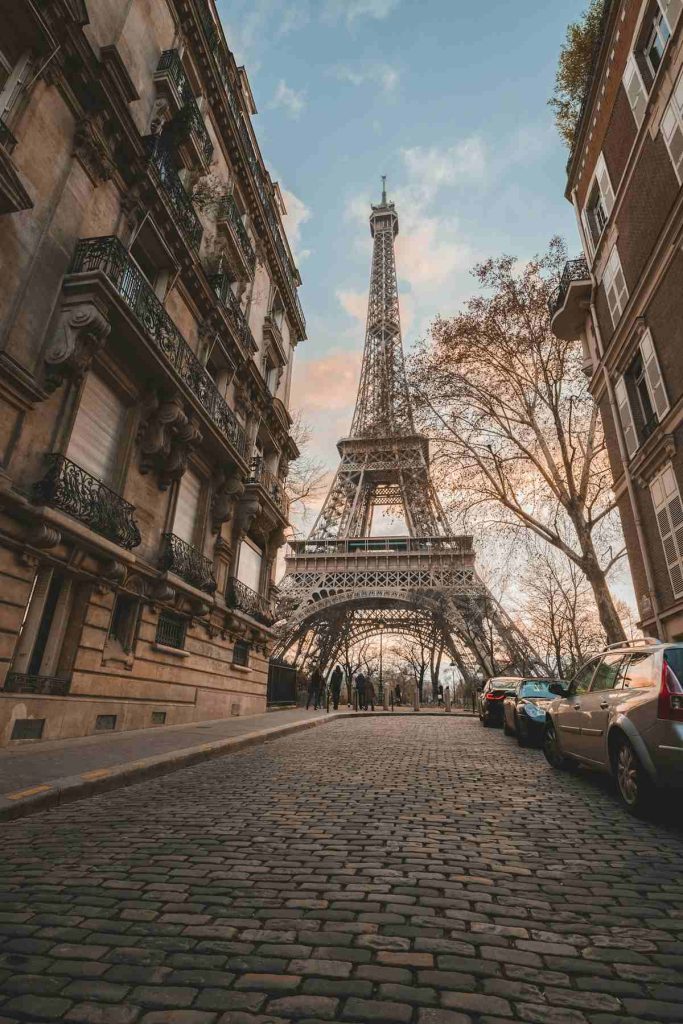
The 7th arrondissement is elegant, calm, and very much a residential quartier. Staying here means the Eiffel Tower is a short walk away — an undeniable thrill for first-timers. The Musée d’Orsay and Les Invalides are also located in this arrondissement.
The area is quieter at night than Le Marais or Montmartre, which suits some travelers perfectly. Accommodation is generally upscale, though options at various price points do exist.
Neighborhood Comparison at a Glance
| Neighborhood | Vibe | Price Range | Best For |
|---|---|---|---|
| Le Marais | Historic, trendy, vibrant | Mid to high | Culture, nightlife, history |
| Montmartre | Romantic, artistic, hilly | Budget to mid | First-timers, romantics |
| Saint-Germain | Elegant, intellectual | High | Literature lovers, luxury stays |
| Latin Quarter | Lively, youthful, diverse | Budget to mid | Solo travelers, students |
| 7th Arrondissement | Quiet, residential, prestigious | Mid to high | Eiffel Tower access, calm stays |
Practical Tips for Choosing Your Neighborhood
- Prioritize metro access. Even if a neighborhood is slightly further from the center, a hotel near a metro station can make it feel just as convenient.
- Book early. Paris is one of the most visited cities in the world. Accommodation in popular neighborhoods fills up quickly, especially during summer and major events.
- Consider your daily itinerary. If the Louvre is your top priority, staying near the 1st or 2nd arrondissement saves considerable time. If your focus is museums along the Seine, the 7th or 6th makes more sense.
- Read recent reviews. Neighborhoods evolve. Checking recent traveler feedback on major booking platforms gives you a current picture of noise levels, safety, and local amenities.
- Don’t overlook vacation rentals. Platforms like Airbnb or local apartment rental agencies can offer genuine neighborhood immersion, especially for stays of a week or more.
Frequently Asked Questions
What is the safest neighborhood in Paris for tourists?
Paris is generally a safe city for tourists in its central arrondissements. Le Marais, Saint-Germain-des-Prés, and the 7th arrondissement are consistently considered among the most comfortable areas for visitors. As in any major city, it’s advisable to stay aware of your surroundings, especially in crowded tourist spots where pickpocketing can occur.
Is Montmartre safe for solo female travelers?
The upper village area of Montmartre, around Sacré-Cœur and the Place du Tertre, is generally considered safe and pleasant. The lower section near Pigalle can feel less comfortable late at night, so solo travelers may prefer to return to their accommodation via metro after dark rather than walking through that area.
Which Paris neighborhood is best for families with children?
The 7th arrondissement and the areas around the Luxembourg Gardens in the 6th are particularly family-friendly, with parks, open spaces, and a calm residential atmosphere. Le Marais is also a good choice given its walkability and variety of family-friendly museums.
How many days do I need in Paris as a first-timer?
Most travel advisors suggest a minimum of four to five days for a first visit to Paris to cover the essential landmarks without feeling rushed. A week or more allows you to explore individual neighborhoods at a comfortable pace and venture beyond the main tourist circuit.
Conclusion
There is no single “best” neighborhood in Paris — the right choice depends entirely on your priorities, your budget, and the kind of trip you want to have. Le Marais offers unmatched energy and central convenience. Montmartre delivers romance and relative affordability. Saint-Germain brings elegance and literary heritage. The Latin Quarter suits independent travelers on a tighter budget. And the 7th arrondissement offers prestige and proximity to Paris’s most iconic landmark.
Whatever you choose, Paris rewards curiosity. Spend time in your neighborhood, walk its streets without a fixed agenda, and let the city reveal itself gradually. That, more than any single attraction, is what makes a first visit to Paris unforgettable.