The Batobus Route in Paris: All 9 Stops and What to Expect at Each One
If you’re trying to figure out whether the Batobus is worth it for your Paris trip, the short answer is: it depends entirely on where you’re staying and what you want to see. It’s not a river cruise — it doesn’t come with commentary or a fixed schedule in the same way. Think of it more like a hop-on, hop-off water bus that follows the Seine and drops you close to the city’s most visited landmarks. Done right, it can save you a lot of walking and metro stress.
Here’s a full breakdown of the route, what’s near each stop, and how to actually plan your day around it.
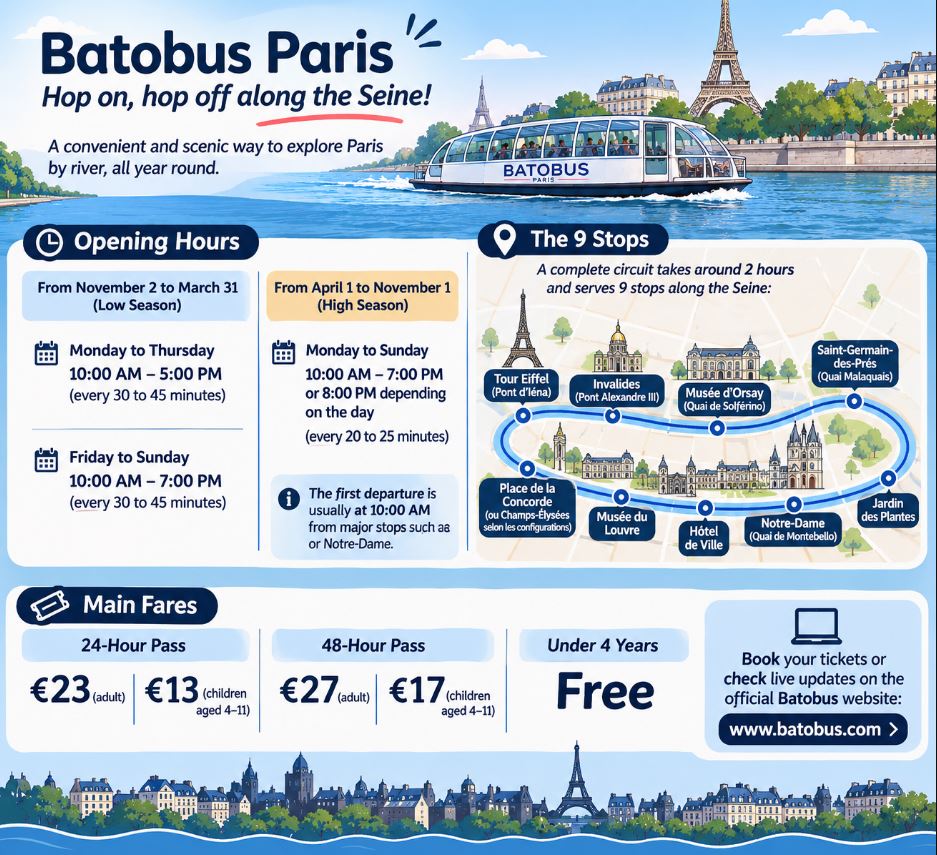
The Full Batobus Route: 9 Stops Along the Seine
The Batobus runs in a loop along the Seine, connecting the major tourist areas from the Eiffel Tower in the west to the Jardin des Plantes in the east. As of 2025–2026, the nine official stops are:
- Tour Eiffel (Port de la Bourdonnais)
- Musée d’Orsay (Quai de Solférino)
- Saint-Germain-des-Prés (Quai Malaquais)
- Notre-Dame (Quai de Montebello)
- Jardin des Plantes (Quai Saint-Bernard)
- Hôtel de Ville (Quai de l’Hôtel de Ville)
- Musée du Louvre (Quai du Louvre)
- Palais Royal – Musée du Louvre / Champs-Élysées stop varies by season
- Trocadéro (depending on the season, this stop may be included or replaced)
Note: The exact stops and operating hours can vary between high season (spring–summer) and low season. Always check the official Batobus website before your trip for the most up-to-date schedule.
Stop by Stop: What to See and How Long to Spend
Tour Eiffel
This is the most popular boarding point and usually the busiest. The stop is on the south bank, a short walk from the tower itself. If you’re visiting the Eiffel Tower, it makes sense to start or end your Batobus day here. The Champ de Mars is just behind you if you want to sit down and take a breath before or after the visit. From here, the boat heads east toward the Musée d’Orsay.
Musée d’Orsay
Getting off here puts you right in front of one of Paris’s best museums — Impressionist and Post-Impressionist collections that most people say are more manageable than the Louvre. The stop is on the left bank (south side of the river). If you’re not going into the museum, the neighbourhood is worth exploring: Rue de Bac and the area around Saint-Germain are a 10-minute walk.
Saint-Germain-des-Prés
Still on the left bank, this stop drops you close to the famous literary cafés (Les Deux Magots, Café de Flore) and the church of Saint-Germain-des-Prés itself. It’s a good spot for lunch or browsing bookshops. This area is also very walkable — you’re not far from the Luxembourg Gardens if you feel like stretching your legs.
Notre-Dame
Notre-Dame’s exterior restoration is well underway and the cathedral reopened to visitors in December 2024, which makes this stop much more relevant again than it’s been for the past few years. You step off near the Quai de Montebello, with the cathedral visible directly across on the Île de la Cité. The Sainte-Chapelle is also close by — worth the detour if Gothic stained glass is your thing.
Jardin des Plantes
This is the easternmost stop and a bit off the typical tourist trail. The botanical garden itself is free to walk through, and the natural history museum nearby is a nice option if you’re traveling with kids. It’s quieter than the other stops, which is partly why it’s worth considering if you want to avoid crowds.
Hôtel de Ville
The stop near Paris’s city hall puts you within easy reach of the Marais district — one of the best neighbourhoods for galleries, falafel on Rue des Rosiers, and the Place des Vosges. This is also a convenient stop if you’re planning to visit the Centre Pompidou, which is about a 10-minute walk north.
Musée du Louvre
The boat pulls in close to the Pont des Arts (the old padlock bridge) and you’re a short walk from the Louvre’s main entrance via the glass pyramid. If you have a timed entry ticket for the Louvre, this is obviously the stop to use. The area around the Palais Royal is also worth seeing even if you skip the museum.
Practical Tips for Planning Your Batobus Day
How to buy tickets
You can buy tickets directly at any of the boarding stations or online. A day pass gives you unlimited hop-on, hop-off access. There are also multi-day passes if you’re staying in Paris for a few days and want flexibility. The Batobus is not included in the standard Paris Visite metro card, so check in advance whether a combined transport pass makes sense for your trip.
How often do boats run?
During high season (roughly April through October), boats run every 20 to 30 minutes. In low season, the frequency drops and some stops may be closed. Early morning and evening service may also be limited. If you’re planning a full day of stops, start before noon.
How long does the full loop take?
Doing the full loop without getting off takes roughly 1 hour and 40 minutes. In practice, most people get off at two or three stops, explore on foot, then reboard. A realistic full-day itinerary — say, Eiffel Tower → Notre-Dame → Marais → Louvre — works well if you don’t try to do too much at each stop.
Is it worth the money?
Honestly? If you’re mainly doing museums that are right on the river (Orsay, Louvre) and also visiting the Eiffel Tower and Notre-Dame, then yes — it removes a lot of metro connections. If your itinerary includes Montmartre, the Père Lachaise, or Versailles, the Batobus won’t help you much. It’s a tool for the riverbank, not the whole city.
Suggested Itineraries Based on Your Interests
- Art lovers: Board at Tour Eiffel → Musée d’Orsay (get off, visit) → reboard → Louvre (get off, visit). Full day, two world-class museums.
- History and architecture: Board at Hôtel de Ville → walk through the Marais → reboard → Notre-Dame. Add Sainte-Chapelle if time allows.
- Families with kids: Tour Eiffel → Jardin des Plantes (natural history museum) → Hôtel de Ville. Easy pacing, mix of outdoor and indoor.
- Half-day option: Saint-Germain → Notre-Dame → Louvre. Three of the most iconic spots, one bank, manageable on foot between stops.
The Batobus is one of those things that Paris visitors either swear by or ignore completely. If the Seine runs through your itinerary — which it does for most people spending two to four days in the city — it’s worth having the route in your back pocket. Even if you only use it for one leg of a journey, arriving by river with the Eiffel Tower or Notre-Dame coming into view is an experience that the metro simply can’t replicate.