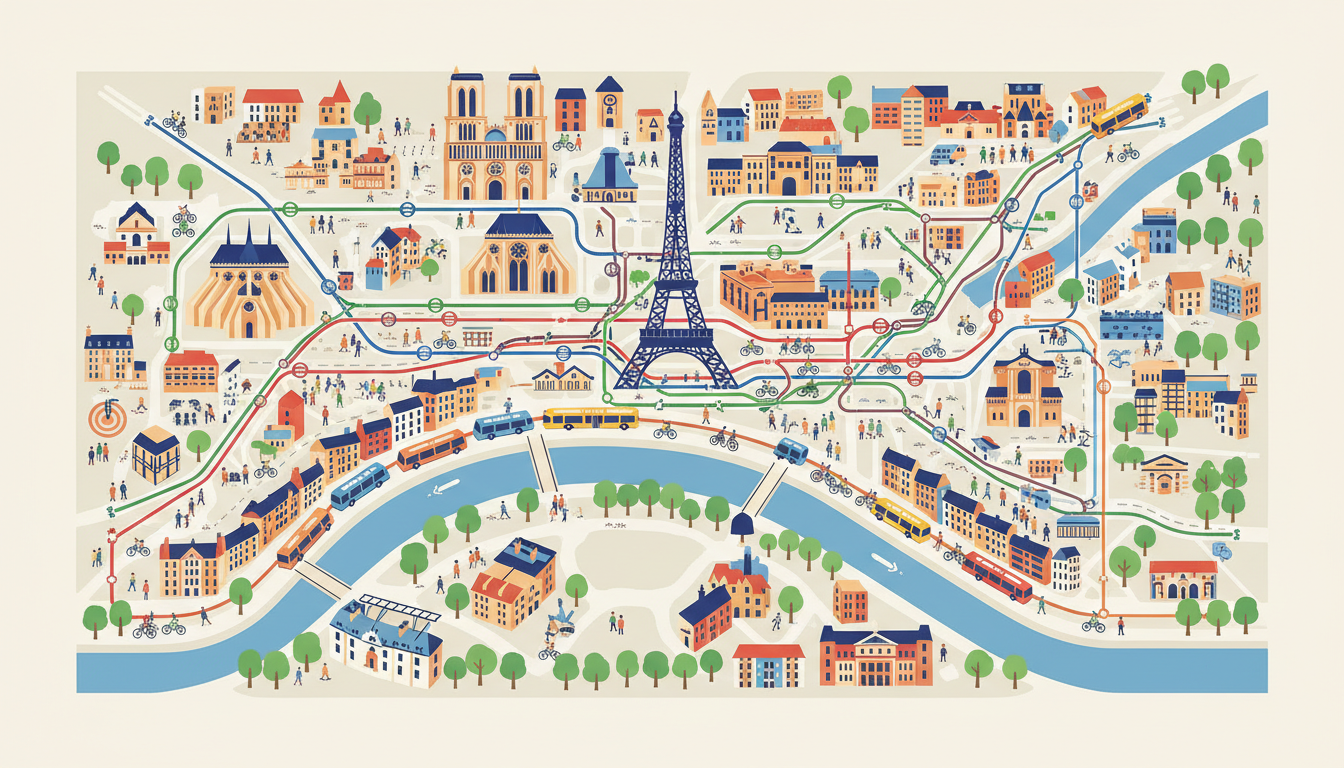
Paris has five main ways to get around: metro, buses, taxis and ride apps, bikes, and walking. Most visitors use a mix. The metro is fastest for longer distances, walking works well in central neighborhoods, and taxis make sense when you have luggage or late nights. Each has trade-offs in cost, comfort, and accessibility.
Key points
- The metro covers most tourist areas quickly and cheaply, but involves stairs and crowds
- Walking between nearby attractions (Louvre to Musée d’Orsay, Latin Quarter to Notre-Dame) often beats waiting for transport
- Taxis and ride apps cost more but solve luggage, mobility, and late-night problems
- Buses take longer but let you see the city; bikes work well for confident riders
- One transport type rarely works for an entire trip, combine methods based on the situation
Choosing transport by situation
The best option changes based on distance, time of day, what you’re carrying, and who’s traveling. A family with a stroller faces different constraints than a solo traveler with a backpack.
Short distances (under 1.5 km)
Walk. You’ll see more, save money, and often arrive faster than waiting for transport.
Medium distances (1.5-5 km)
Metro if it’s a direct line or one change. Walking if the weather is good and you’re not in a hurry.
Long distances (over 5 km)
Metro for speed and cost. Taxi if you have luggage, mobility issues, or it’s late at night.
With heavy bags or strollers
Taxi or ride app. Most metro stations lack elevators, and buses require folding strollers.
Late night (after midnight)
Taxi or night buses (Noctilien). The metro stops around 1:15 am on weeknights, 2:15 am on weekends.
Budget priority
Metro and walking. A single ticket costs under €2.50; a day pass (Navigo Jour) covers unlimited rides.
Metro: fast and cheap, but not always easy
The Paris metro is the default for distances over 1.5 km. It’s fast, runs frequently (every 2-8 minutes during the day), and reaches most major sights. Fourteen lines crisscross the city, and you can transfer between lines on one ticket within 90 minutes.

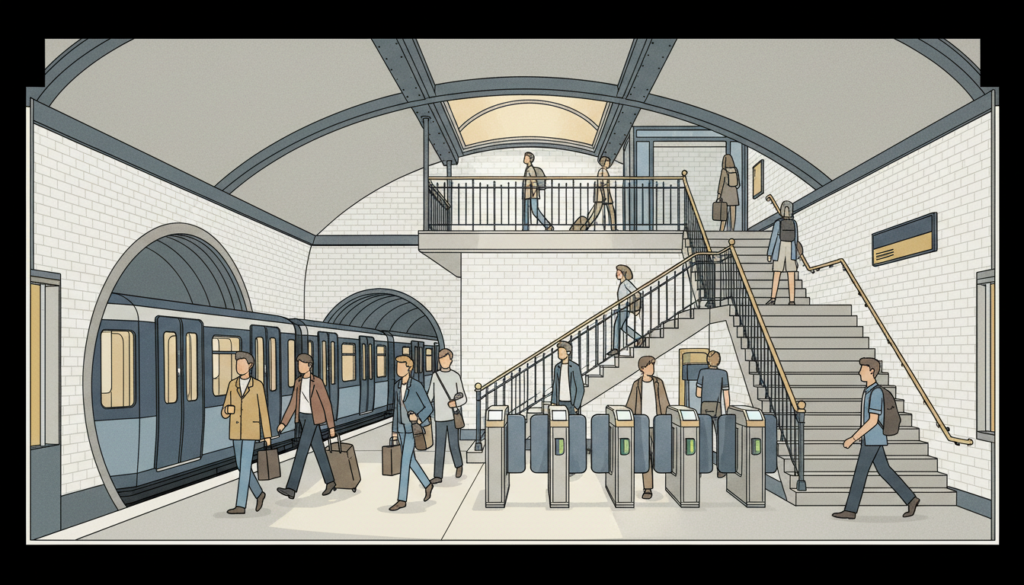
The downsides: most stations have stairs only, platforms get crowded during rush hours (8-9:30 am, 5:30-7:30 pm), and the system shuts down after 1 am most nights. Pickpockets work busy lines and tourist-heavy stations. If you have a large suitcase, a stroller, or mobility challenges, the metro creates real problems.
Tip
Lines 1 and 14 are fully automated with platform doors, making them cleaner and safer. Line 1 connects many tourist areas: Louvre, Champs-Élysées, Bastille.
Single tickets work for one journey with transfers. If you’re making more than five trips in a day, a day pass saves money. For stays of a week or more, a weekly Navigo pass covers metro, buses, and RER in central zones.
Buses: slower but scenic
Buses use the same tickets as the metro but take longer because of traffic. The advantage: you see the city above ground, routes often run along scenic streets, and some buses have space for luggage or unfolded strollers (check with the driver).
Useful tourist routes include the 69 (Eiffel Tower to Père Lachaise), 87 (Eiffel Tower to Latin Quarter), and 96 (Gare Montparnasse to Gare du Nord). Buses display the next stops on screens inside, but you need to press the stop button or the driver may not stop.
Night buses (Noctilien) run after the metro closes, but routes are limited and frequencies drop to every 30-60 minutes. Check the RATP website for current schedules before relying on them.
Taxis and ride apps: when convenience matters
Taxis and ride apps cost roughly ten times more than the metro per trip, but they solve specific problems: luggage, mobility limits, late arrivals, traveling with kids, and door-to-door service when you’re tired.
Official taxis (white cars with a roof light) charge metered fares. Ride apps (Uber, Bolt, G7) show the price upfront. Both are reliable; the choice depends on whether you prefer a meter or a fixed price. Taxis can use bus lanes, sometimes making them faster than ride apps in traffic.
Pros
- No stairs, no crowds, no navigating
- Works with any amount of luggage
- Available 24 hours
- Faster late at night when traffic is light
Cons
- Expensive for multiple daily trips
- Traffic delays during rush hours
- Hard to find taxis at peak times without booking ahead
- Language barrier with some drivers
Common mistake: assuming taxis are always faster. During midday traffic, the metro often wins for cross-city trips. Taxis make sense for short trips with luggage, airport runs, and late-night returns to your hotel.

Walking: underrated and often fastest
Central Paris is compact. The distance from the Louvre to Notre-Dame is 1.5 km (about 18 minutes). From Notre-Dame to the Panthéon is 1 km. From the Eiffel Tower to Trocadéro is 800 meters. Many visitors take the metro for trips they could walk in less time than waiting on a platform.
Walking in Paris lets you see details you’d miss underground: architecture, shop windows, cafés, small streets. It’s free, healthy, and flexible, you can stop when something catches your eye. The main constraint is weather and how much you’re carrying.
Use a map app to check walking time before defaulting to the metro. If it’s under 20 minutes and you’re not hauling luggage, walking is often the better choice.
Bikes and scooters: for confident riders
Paris has expanded bike lanes in recent years, and the Vélib’ bike-share system offers thousands of bikes at stations across the city. Electric scooter rentals (Lime, Dott) are also available. Both work well if you’re comfortable riding in city traffic and navigating cobblestones.
Bikes cost less than taxis and cover ground faster than walking, but they require attention. Paris drivers don’t always yield, bike lanes sometimes disappear mid-route, and you need to watch for pedestrians. Helmets aren’t required but are a good idea.
Warning
Don’t ride on sidewalks, it’s illegal and you can be fined. Lock bikes securely; theft is common.
Bikes make sense for confident cyclists staying in one area (the Marais, along the Seine, around Montmartre). They’re less practical if you’re covering the whole city or traveling with kids who can’t ride independently.
Getting to and from airports
Public transport from CDG (RER B train) is the cheapest option but involves stairs, crowds, and no space for large luggage. It works if you’re traveling light and staying near a station on the line. The trip takes 30-50 minutes depending on your final stop, plus time to navigate the airport and metro connections.
Private transfers cost more but deliver you door-to-door with help for luggage. The trade-off is cost versus convenience. For families, late arrivals, or travelers with mobility issues, the extra cost often makes sense. For solo travelers with a backpack arriving midday, the train is fine.
Orly airport is closer to the city and served by the Orlyval light rail connecting to RER B, or by bus. Beauvais is far from Paris (80 km) and requires a dedicated bus; factor in 90 minutes minimum.
Luggage and accessibility challenges
Most metro stations have stairs only. Escalators exist at some stations, but elevators are rare outside major hubs. If you have a large suitcase, a stroller, or use a wheelchair, the metro becomes difficult or impossible for many trips.
Luggage and mobility in Paris requires planning. Buses accommodate some strollers and wheelchairs, but space is limited and you may need to wait for the next bus. Taxis and ride apps are the reliable solution when accessibility matters, though they add cost.
Some hotels offer luggage storage if you arrive before check-in or leave after checkout. Luggage lockers exist at major train stations but not at most tourist sites. Plan your arrival and departure days around luggage constraints rather than assuming you can easily move bags across the city.

Common mistakes visitors make
Over-relying on one transport type. The metro is great for some trips, terrible for others. Walking works well in central areas but not for crossing the entire city. Taxis solve luggage problems but drain your budget if you use them for every trip.
Underestimating walking time. Map apps show straight-line distances, but Paris streets curve and you’ll stop for traffic lights. Add 20-30% to estimated times, especially if you’re unfamiliar with the area.
Not checking metro station accessibility before booking a hotel. If your hotel is near a metro station with no elevator and you have mobility issues or heavy bags, you’ve created a daily problem.
Note
Rush hour crowding is real. If you’re traveling between 8-9:30 am or 5:30-7:30 pm, expect packed metro cars and platforms. Buses are less crowded but slower due to traffic.
Ignoring train stations when planning day trips. Paris has six major stations, each serving different regions. Versailles leaves from different stations depending on which train you take. Check your departure station when booking trips outside Paris.
Building a transport strategy
Most visitors use a combination: metro for longer distances between neighborhoods, walking within neighborhoods, and taxis for luggage days and late nights. Buy a day pass or weekly Navigo if you’re making many metro trips; otherwise, single tickets work fine.
- Map your hotel location Check proximity to metro stations and whether they have elevators if accessibility matters.
- Identify clusters Group nearby sights to minimize transport between them. Walk within clusters, take the metro between clusters.
- Plan luggage days Book a taxi or transfer for arrival and departure if you have more than a small bag. Don’t assume you can manage large luggage on the metro.
- Check walking distances Before taking the metro, see if walking time is under 20 minutes. You’ll often save time and see more.
- Keep backup options Have a taxi app installed and some cash for situations where your primary plan fails (metro closure, strike, exhaustion).
Paris transport works well once you match the method to the situation. No single option is always best, and the visitors who move around most easily are the ones who adapt their choice trip by trip.
Is the Paris metro safe at night?
The metro itself is generally safe, but it stops running around 1:15 am on weeknights (2:15 am Friday and Saturday). Late-night platforms can be empty, and some stations in outer areas are less comfortable after dark. If you’re out past midnight, plan for a taxi or night bus rather than assuming the metro will be running.
Can I use the same ticket for metro and bus?
Yes. A single ticket (t+ ticket) is valid for metro, buses, trams, and RER within central Paris for 90 minutes, including transfers between metro lines or between buses. You cannot transfer between metro and bus on the same ticket, though, that requires a new ticket or a pass.
Do I need to buy transport tickets in advance?
No, but it saves time. You can buy tickets at metro station machines (they accept cards and cash) or from ticket windows. Machines have English language options. If you’re making multiple trips, buying a carnet (pack of 10 tickets) or a day pass at the start saves queuing later.
How much does a taxi from CDG airport to central Paris cost?
Official taxis charge a flat rate: check the current rate with Paris Aéroport before your trip, as prices adjust periodically. Right-bank destinations and left-bank destinations have different rates. Ride apps show the price upfront when you book. The trip takes 30-60 minutes depending on traffic and your destination.
Can I bring a suitcase on the metro?
Yes, there’s no rule against it, but most stations have stairs only, making it physically difficult. If you have a large or heavy bag, expect to carry it up and down stairs, navigate turnstiles, and manage crowded platforms. A small rolling bag is manageable; large suitcases are better in a taxi.
How this article was made: drafted with AI assistance from an outline and notes by paris75, then reviewed, fact-checked and edited by paris75 before publication. Images are AI-generated illustrations.