
Paris is one of the most visited cities on the planet, and honestly, most trips go completely smoothly. But there’s a reason experienced travelers always tell first-timers to stay alert — the city also attracts a fair share of people looking to take advantage of distracted tourists. The good news? Most scams are easy to avoid once you know what to look for. This guide walks you through the most common ones and, crucially, where they tend to happen so you can stay one step ahead.
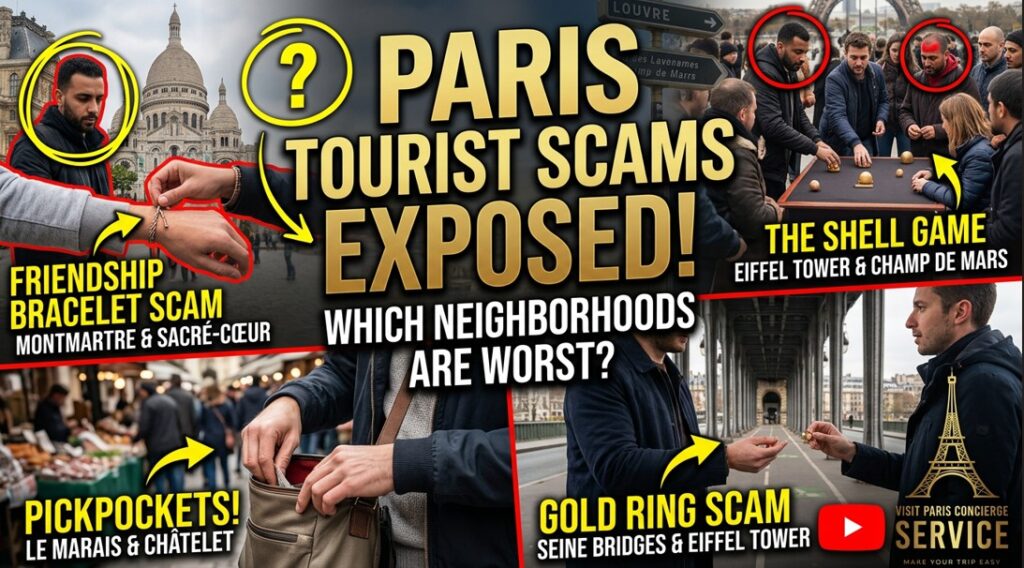
The Friendship Bracelet Trick
This one is almost a Paris classic at this point. You’re walking near a famous monument when someone approaches you, grabs your wrist, and starts weaving a “friendship bracelet” around it before you even realize what’s happening. By the time it’s tied on, they’re demanding payment — often aggressively, and sometimes with accomplices nearby to block your exit.
Where it happens most: The steps leading up to the Sacré-Cœur in Montmartre are practically ground zero for this scam. It also shows up regularly around the Eiffel Tower and the Pont de l’Alma area.
How to avoid it: Keep your hands in your pockets and walk with purpose. If someone reaches for your wrist, pull back immediately and keep moving. A firm “non merci” while keeping your eyes forward works well.
The Petition Scam
A group of young people — often teenagers — approach you with a clipboard and ask you to sign a petition for a “good cause” (deaf children, hunger relief, etc.). While you’re distracted reading and signing, another person in the group pickpockets you. Sometimes after signing, they’ll also pressure you to make a cash donation.
Where it happens most: This one is very common around the Louvre, the Eiffel Tower, and along the Champs-Élysées. It also pops up near major Metro stations like Châtelet–Les Halles.

How to avoid it: Simply don’t stop. You don’t owe anyone an explanation. If someone blocks your path, step around them without making eye contact. Keep your bag in front of you at all times in these areas.
The “Found Ring” Scam
Someone bends down right in front of you, picks up a gold ring off the ground, and says “is this yours?” or “you must be lucky — keep it.” Then comes the ask: a small “gift” of money in return for their generosity, or they follow you trying to sell the ring as if it’s valuable. Spoiler: it’s not. These rings are bought in bulk and are worth almost nothing.
Where it happens most: Along the Seine riverbanks, especially near the Pont des Arts and the Trocadéro area. Also common near the Louvre entrance.
How to avoid it: Just keep walking. Don’t look at the ring, don’t engage with the story. The moment you pause out of curiosity is the moment they have your attention.
Pickpockets on the Metro
This is less of a scam and more of a straightforward theft — but it’s worth including because tourists consistently underestimate how organized some pickpocket groups are in Paris. They often work in teams: one person causes a distraction (drops something, asks a question, creates a small scene near the doors), while another lifts your wallet or phone.
Where it happens most: Lines 1 and 4 are the most targeted, particularly around stops like Châtelet, Gare du Nord, Gare de l’Est, and Charles de Gaulle–Étoile. Crowded tourist-heavy trains are the main hunting ground.
How to avoid it:
- Keep your phone in a front pocket or inside a zipped bag, never in a back pocket
- Be especially alert when boarding or exiting trains — the door crush is a common moment for theft
- If someone bumps into you repeatedly or someone’s behavior feels off, trust your instincts
- Use a crossbody bag that you keep in front of you on busy trains
The Overcharging Taxi (or Fake Taxi)
While official Paris taxis are regulated and generally fine, unofficial drivers near major transport hubs sometimes approach travelers offering rides at “fixed” prices that end up being two or three times what a legitimate fare would cost. At airports in particular, this is more common than you’d think.

Where it happens most: Outside Gare du Nord (one of the busiest train stations in Europe), Charles de Gaulle Airport, and Orly Airport. Basically anywhere you arrive looking tired and loaded with luggage.
How to avoid it: Only take official taxis from clearly marked taxi stands, or use a rideshare app. From CDG to central Paris, a legitimate taxi fare should be a fixed rate — around €55 to the Right Bank, €62 to the Left Bank (these are regulated fixed prices, as of recent years). If someone quotes you something wildly different, walk away.
The Three-Card Monte and Shell Games
Street gambling setups — usually three-card monte or shell games — look like fun and easy money. They’re not. The operator is a professional, and the people “winning” around the table are almost always shills who are part of the operation. The game is rigged from the start.
Where it happens most: Near the Eiffel Tower, around the Champs-Élysées, and sometimes in busy park areas like the Trocadéro gardens.
How to avoid it: Just don’t stop. Even watching from a distance can pull you in psychologically. If you see a crowd gathering around a folding table on the street, keep walking.
Fake Museum or Attraction Tickets
With queues at the Louvre and Versailles sometimes stretching for hours, it’s tempting when someone outside offers to sell you skip-the-line tickets at a “discount.” These tickets are often fake, expired, or stolen, and you’ll only find out when you get to the entrance and are turned away.
Where it happens most: Outside the Louvre, the Palace of Versailles, and sometimes near the Musée d’Orsay.
How to avoid it: Buy tickets directly from the official websites before your visit. The Louvre, Versailles, and most major museums all sell timed entry tickets online. It’s easier, often cheaper, and completely scam-proof.
A Quick Note on Neighborhoods
To be clear: none of these neighborhoods are dangerous in the way that word sometimes gets used. Montmartre is beautiful. The area around the Eiffel Tower is iconic. Châtelet is convenient for getting around. The point isn’t to avoid these places — it’s simply to be more switched-on when you’re in high-tourist-density areas, because that’s where scammers concentrate their efforts. Quiet residential neighborhoods like the 11th or the 13th arrondissement see very little of this activity precisely because the tourist foot traffic isn’t there.
General Rules That Will Serve You Well
- Slow down before you stop. Scams often rely on catching you mid-stride, distracted.
- Keep valuables in front-facing pockets or bags. This single habit prevents most pickpocketing.
- Don’t feel rude for walking away. Legitimate people don’t aggressively follow tourists down the street.
- Book tickets online. For any major attraction, this eliminates most ticket-related scams entirely.
- Trust your gut. If an interaction feels off, it probably is.