
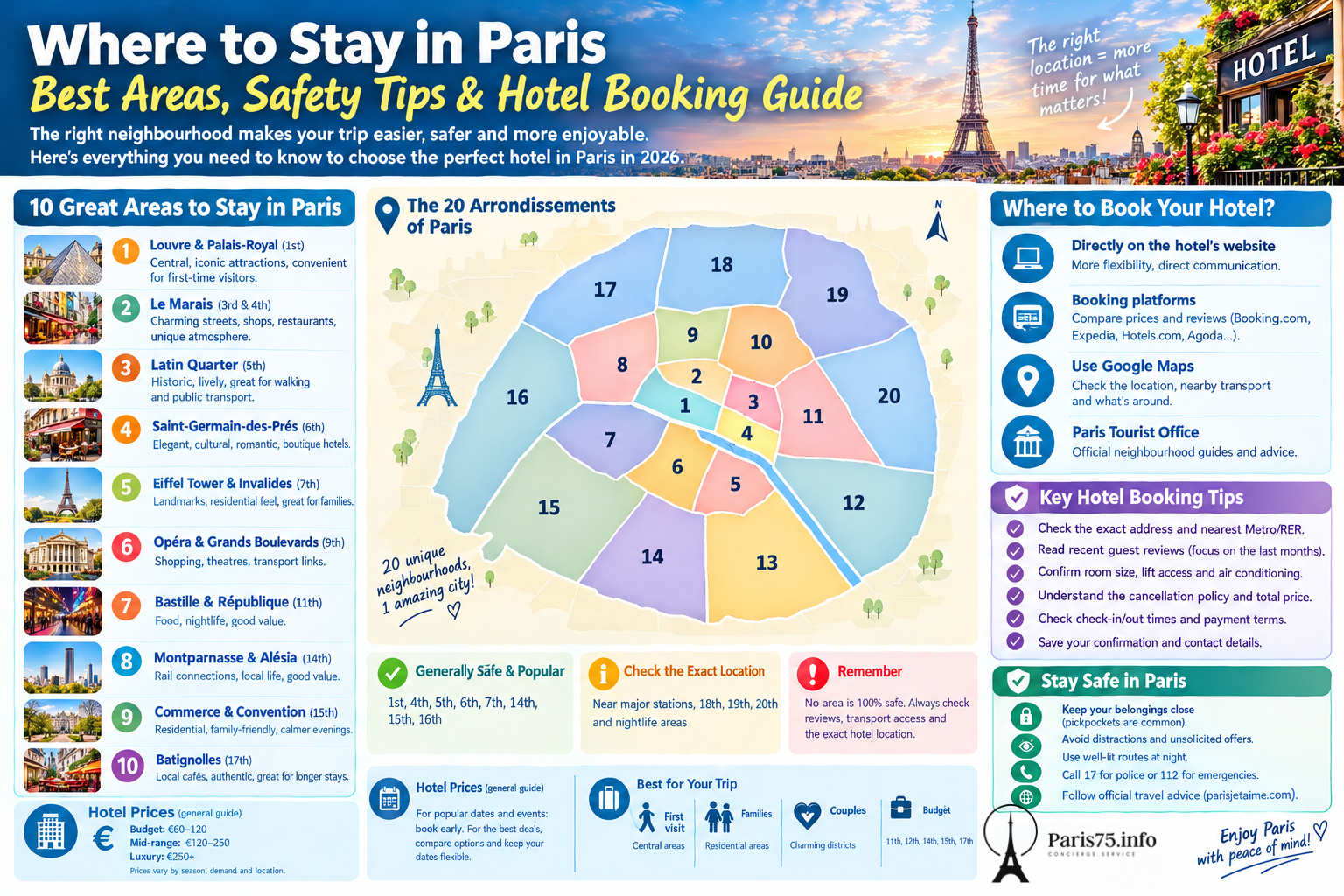
1. Where Is the Best Place to Stay in Paris?
The best neighbourhood depends on your budget, travel style and the places you want to visit. There is no single best area for every traveller, and the most expensive hotel is not necessarily the most suitable one.
| Area | Best for | Budget guide | Main consideration |
|---|---|---|---|
| Louvre and Palais-Royal, 1st arrondissement | First-time visitors and central sightseeing | High | Excellent central location, but accommodation can be expensive |
| Le Marais, 3rd and 4th | Culture, shopping, restaurants and atmosphere | Medium to high | Some streets are lively late into the evening |
| Latin Quarter, 5th | History, cafés and a lively atmosphere | Medium to high | Popular streets can be noisy |
| Saint-Germain-des-Prés, 6th | Couples, boutique hotels and a classic Paris experience | High | Premium accommodation prices |
| Eiffel Tower and Invalides, 7th | Families, landmark views and quieter streets | High | Some hotels are far from the nearest Metro entrance |
| Opéra and Grands Boulevards, 9th | Shopping, theatres and transport connections | Medium to high | Busy streets and traffic in some locations |
| Bastille and the 11th | Restaurants, nightlife and younger travellers | Low to medium, depending on the street | Nightlife can mean noise late at night |
| Montparnasse and Alésia, 14th | Rail connections, local life and value | Medium | Some attractions require a Metro journey |
| Commerce and Convention, 15th | Families and a more residential atmosphere | Medium | Less nightlife and fewer major attractions on the doorstep |
| Batignolles, 17th | Local cafés, residential streets and longer stays | Medium | Check the distance to a Metro station |
These budget labels are relative guides, not guaranteed prices. Hotel rates vary with dates, room size, demand, events and booking conditions.
Our practical recommendation: Start by comparing the 1st, 4th, 5th, 6th, 7th, 9th, 14th and 15th arrondissements. Then compare individual hotels according to their exact location, recent reviews, cancellation policy and total price.
2. Understanding Paris Arrondissements
Paris is divided into 20 municipal districts known as arrondissements. They are numbered in a spiral pattern, beginning in central Paris and continuing outward.
The arrondissement number is a useful starting point when searching for accommodation, but it does not tell you everything about a hotel’s surroundings. Two hotels in the same arrondissement may offer very different experiences depending on the street, nearby transport, nightlife and local amenities.
Central Paris: Arrondissements 1 to 8
These districts contain many of the city’s best-known landmarks, museums, historic streets and shopping areas. Staying here can reduce travel time and make it easier to return to your hotel between activities. The trade-off is that accommodation is often more expensive, particularly in popular locations.
Eastern and northeastern Paris: Arrondissements 10 to 20
These districts include lively restaurant areas, residential neighbourhoods, parks and accommodation options at a range of prices. Some streets are excellent bases for visitors, while others may be less convenient for a particular itinerary.
Greater Paris and the suburbs
Hotels outside the city limits may offer more space or attractive rates. They can be a good choice if you are visiting a specific business district, attending an event or travelling to a destination such as Disneyland Paris.
However, a cheaper room outside central Paris can become less economical if you spend considerable time and money commuting. Before booking, calculate the full journey to the attractions you intend to visit and check the first and last public transport services you may need.
3. The Best Areas to Stay in Paris
1. Louvre and Palais-Royal — 1st arrondissement
Best for: First-time visitors, short city breaks and travellers who want to be close to major landmarks.
The 1st arrondissement is one of the most central places to stay in Paris. The Louvre Museum, the Tuileries Garden, the Palais-Royal and the Seine are all within this part of the city or nearby.
Staying here can make sightseeing easier, particularly if you have only two or three days in Paris. You may be able to walk to several major attractions instead of taking public transport for every outing.
Advantages
- Central location for sightseeing.
- Convenient connections to other parts of Paris.
- Many restaurants, cafés and established hotels.
- Useful for visitors who want to minimise travel time.
Things to consider
- Accommodation can be expensive.
- Popular streets may be busy with tourists.
- Restaurants and rooms close to major attractions may charge premium prices.
Booking tip: Compare the hotel’s distance from a Metro entrance with its distance from the attractions. A hotel a little farther from the busiest landmark may offer better value and a quieter night.
2. Le Marais — 3rd and 4th arrondissements
Best for: Couples, culture lovers, shopping, restaurants and travellers who enjoy exploring on foot.
Le Marais is known for its historic streets, independent boutiques, galleries, cafés and lively food scene. It is an appealing base for visitors who want more than a hotel room close to a monument.
The neighbourhood provides convenient access to parts of central Paris, including the Seine and Île de la Cité. Depending on the location of your accommodation, many restaurants and attractions may be within walking distance.
Advantages
- Distinctive historic atmosphere.
- Plenty of places to eat and shop.
- Good options for walking and exploring neighbourhood streets.
- Metro connections for longer journeys.
Things to consider
- Some streets are busy and noisy in the evening.
- Older buildings may have small rooms, stairs or limited lift access.
- Prices can be high in the most popular sections.
Booking tip: If you are a light sleeper, read recent reviews about street noise and ask whether the room faces a courtyard or a busy road.
3. Latin Quarter — 5th arrondissement
Best for: First-time visitors, history lovers, students, couples and travellers who enjoy a lively atmosphere.
The Latin Quarter combines historic landmarks, bookshops, cafés, restaurants and university life. It is close to the Panthéon, the Sorbonne area and the Luxembourg Gardens, with convenient access to other central neighbourhoods.

The area can be a practical choice for visitors who want a walkable base without staying directly beside the Louvre or another major tourist landmark.
Advantages
- Historic character and an active café culture.
- Many dining options at different price points.
- Convenient for exploring the Left Bank.
- Good public transport connections in many parts.
Things to consider
- Popular streets can be crowded.
- Some restaurants and bars stay busy late.
- Room sizes and building facilities vary considerably.
Booking tip: Look at the exact street and check recent comments about noise, particularly if your room faces a restaurant or busy pedestrian area.
4. Saint-Germain-des-Prés — 6th arrondissement
Best for: Couples, boutique hotels, culture, shopping and a classic Paris atmosphere.
Saint-Germain-des-Prés is associated with historic cafés, galleries, elegant streets and a refined Left Bank atmosphere. It is well placed for visitors who want to walk, enjoy long meals and explore museums and cultural landmarks.
The neighbourhood is often chosen for romantic trips and special occasions, but its appeal comes with a higher accommodation budget in many locations.
Advantages
- Attractive streets and a strong café culture.
- Good access to central Left Bank attractions.
- Many boutique and upscale accommodation options.
- A convenient base for walking and dining.
Things to consider
- Hotel rates can be high.
- Some small hotels offer compact rooms.
- Popular cafés and streets can become busy.
Booking tip: Check the total cost, room dimensions, lift access and air conditioning rather than choosing a hotel solely for its address.
5. Eiffel Tower and Invalides — 7th arrondissement
Best for: Families, couples, landmark-focused visits and travellers who prefer many residential streets.
The 7th arrondissement is home to the Eiffel Tower area, the Invalides complex and attractive residential streets. It is particularly appealing if seeing the Eiffel Tower is a major priority for your trip.
Some parts of the district feel quieter than the busiest nightlife areas, although visitor numbers around major landmarks can be substantial. A hotel described as being near the Eiffel Tower may still require a walk or a transport connection to reach the tower itself.
Advantages
- Close to major landmarks and museums.
- Many residential streets and local amenities.
- Suitable for travellers who prefer a less nightlife-focused base.
- Attractive for landmark views, depending on the hotel.
Things to consider
- Hotels with landmark views can be expensive.
- Not every location has a Metro station immediately nearby.
- Tourist crowds can be significant around popular sights.
Booking tip: Verify the walking route to the nearest Metro station and the exact location of any advertised Eiffel Tower view.
6. Opéra and Grands Boulevards — 9th arrondissement
Best for: Shopping, theatres, department stores, restaurants and convenient transport connections.
The 9th arrondissement is a practical choice for visitors who want a central base with plenty to do. The area around Opéra, the Grands Boulevards and department stores offers a mix of hotels, restaurants and cultural attractions.
It can work well for short visits and travellers who expect to use public transport frequently. However, individual streets vary in traffic, noise and atmosphere.
Booking tip: Compare hotels near the Metro with those closer to major roads. A quieter side street may make a noticeable difference to your sleep.
7. Bastille and République — 11th arrondissement
Best for: Food lovers, younger travellers, nightlife and visitors who want a lively neighbourhood.
The 11th arrondissement has a strong restaurant and bar scene, with busy streets and a wide choice of casual places to eat. It can offer good value compared with some of the most expensive central districts, although prices vary by street and date.
Advantages
- Many restaurants, bars and cafés.
- Metro connections to several parts of Paris.
- A lively local atmosphere.
- Potentially better value than some prime tourist locations.
Things to consider
- Some streets are noisy late at night.
- The atmosphere varies considerably around nightlife venues.
- You may need public transport for some major sightseeing trips.
Booking tip: If you prefer quiet evenings, choose a hotel away from late-night bars and read recent reviews about sound insulation.
8. Montparnasse and Alésia — 14th arrondissement
Best for: Rail travellers, longer stays, local neighbourhood life and visitors looking for a balance between price and convenience.
The 14th arrondissement includes Montparnasse, Alésia and residential streets with shops, bakeries and cafés. It can be a sensible option for visitors who want a practical base without paying the highest central-Paris hotel rates.
Montparnasse is particularly useful for travellers arriving by train at Gare Montparnasse or planning onward rail journeys from that station.
Booking tip: Check whether the hotel is closer to Montparnasse-Bienvenüe, another Metro station or the railway station itself. The district covers a substantial area, so the exact address matters.
9. Commerce and Convention — 15th arrondissement
Best for: Families, longer stays, residential surroundings and visitors who value a calmer evening atmosphere.
The 15th is a large district with shopping streets, parks, cafés and residential areas. It can be a good choice for travellers who do not need to sleep immediately beside a major attraction and are happy to use public transport.
Advantages
- Many residential streets.
- Everyday amenities, including supermarkets and bakeries.
- Accommodation choices for different budgets.
- Useful connections from many parts of the district.
Things to consider
- Some hotels are a considerable walk from central attractions.
- The district is large, so transport access differs by location.
- Views and proximity to the Eiffel Tower should be checked rather than assumed.
Booking tip: Compare the actual journey time to your main attractions instead of relying only on the arrondissement name.
10. Batignolles — 17th arrondissement
Best for: Longer stays, neighbourhood cafés, residential surroundings and travellers who want a more local feel.
Batignolles has cafés, small shops, restaurants and residential streets. It can be an appealing alternative to the busiest tourist districts, particularly if you are comfortable taking the Metro for sightseeing.
Booking tip: Check the distance to the nearest Metro station and the number of changes required to reach your planned destinations.
4. What Are the Safest Areas to Stay in Paris?
Travellers often search for the safest neighbourhood in Paris, but there is no reliable way to guarantee that any district is completely safe. Personal safety depends on several factors, including the exact street, time of day, transport route, crowd levels and individual circumstances.
For many visitors, a practical choice is a well-reviewed hotel on a well-connected street with nearby restaurants, shops and transport. Some residential parts of the 5th, 6th, 7th, 14th, 15th and 16th arrondissements may appeal to travellers looking for a calmer setting. Parts of the 1st and 4th can also be convenient for central sightseeing.
These are recommendations based on location, amenities and general atmosphere—not an official ranking of crime rates. A hotel’s precise address matters more than the arrondissement number alone.
Areas worth comparing for a calmer stay
Saint-Germain-des-Prés and selected parts of the 6th
This area has established hotels, cafés and attractive streets. It is popular with couples and visitors who want a central base. Prices can be high, and busy commercial streets are not necessarily quiet at every hour.
Selected residential streets in the 7th
Some parts of the 7th have a residential character and are convenient for landmark visits. Check the hotel’s surroundings and transport connections, particularly if you plan to return late at night.
Residential parts of the 14th and 15th
These districts can suit visitors who prefer local shops and residential streets over nightlife. They are also worth comparing for accommodation value. Check the walking route from the station and the services available near your hotel.
Selected parts of the 16th
The 16th includes residential areas around Passy, Auteuil and Trocadéro. Some streets have a quieter atmosphere, but hotel prices and transport access vary. Do not assume every hotel in the district is equally convenient.
Central locations near major attractions
Staying centrally can reduce the need for long journeys late in the evening. However, busy tourist areas also attract pickpockets, and crowds can make it easier to lose track of your belongings.
How to assess safety before booking
- Check the exact hotel address on a map.
- Use recent reviews to identify repeated comments about the immediate surroundings, noise and late-night access.
- Check the walking route between the nearest Metro station and the hotel.
- Look for nearby shops, restaurants and staffed public areas that suit your arrival time.
- Consider whether you will be returning alone late at night.
- Read current official travel and safety advice before your trip.
Important: Avoid treating internet lists of “safe” and “unsafe” arrondissements as definitive crime maps. They often oversimplify a large, diverse city and may not reflect current conditions.
For current visitor safety advice, consult the Paris Tourist Office and its practical safety guidance.
5. Areas Where You Should Check the Exact Location Carefully
This section is not a list of neighbourhoods to avoid. Many visitors stay comfortably in all parts of Paris. The purpose is to explain why checking the precise street, transport connection and hotel reviews is more useful than relying on broad labels.
Around major railway stations
Areas near Gare du Nord, Gare de l’Est, Gare de Lyon and other major stations can be convenient if you are arriving by train or leaving early the next morning.
However, station surroundings can be crowded, noisy and busy with traffic. The atmosphere may change considerably from one street to the next. If you are arriving late, check the walking route from the station, the hotel entrance and the transport options available at your arrival time.
Parts of the 18th arrondissement
Montmartre is a popular area known for its artistic history, hillside streets, cafés and Sacré-Cœur. It can be a charming place to stay, but the 18th arrondissement is large and varied.
Compare the exact location of a hotel rather than judging it by the arrondissement alone. Some accommodation is close to popular sights and transport; other locations involve steep walks or longer connections.
If you plan to return late, check the route between the Metro station and your accommodation and read recent reviews about the immediate surroundings.
Parts of the 19th and 20th arrondissements
These districts include residential neighbourhoods, parks, cultural venues and areas with a strong local identity. They may offer attractive prices, but the experience can vary from one neighbourhood to another.
For a short first visit, compare the total journey time to the attractions on your itinerary. A cheaper room may not be worthwhile if you spend much of your holiday commuting.
Streets with heavy nightlife
Areas with many bars, clubs and late-night restaurants can be excellent for travellers who want nightlife. They may be less suitable if you need quiet evenings or are travelling with young children.
Read reviews that mention noise, windows, sound insulation and the experience of returning to the hotel after dark.
Accommodation far from public transport
A hotel can be in a generally appealing district but still be inconvenient if the nearest station is a long walk away. This matters particularly when carrying luggage, travelling with children or returning late.
Rule of thumb: Choose the individual hotel and its immediate surroundings—not just the district name.
6. Where to Stay in Paris Based on Your Type of Trip
Best areas for first-time visitors
If this is your first trip to Paris, prioritise a central location and easy transport connections. The 1st arrondissement, Le Marais, the Latin Quarter and Saint-Germain-des-Prés are all worth comparing.

You may pay more for accommodation, but spending less time travelling can be valuable when you have only a few days to explore the city.
Best areas for families with children
Families may prefer residential parts of the 7th, 14th or 15th arrondissement, or a convenient hotel in the 5th. Look for larger rooms, lift access, breakfast options and easy connections to the attractions you plan to visit.
Before booking, verify the room’s actual sleeping arrangements. A listing that accommodates four guests may contain a double bed and a sofa bed rather than four separate beds.
Best areas for couples
Saint-Germain-des-Prés, Le Marais and selected streets around the 7th are popular choices for couples who enjoy cafés, restaurants, museums and walking.
For a special occasion, compare the room itself, breakfast, view, cancellation policy and total cost rather than paying a premium for the neighbourhood alone.
Best areas for solo travellers
Solo visitors may value a central location, a well-reviewed hotel with a staffed reception and a straightforward route from public transport. The 1st, 5th, 6th and 9th arrondissements are useful starting points for comparison.
If you expect to return late, check the hotel’s check-in arrangements, entrance access and the route from the station. Choose based on your comfort and travel plans rather than assuming that any area guarantees safety.
Best areas for budget travellers
Consider selected hotels in the 11th, 12th, 14th, 15th and 17th arrondissements, and compare suitable options near well-connected Metro stations. You may also find deals in other districts depending on your dates.
Compare the full price, including taxes, breakfast, luggage storage, cancellation conditions and transport costs. A room with a low headline rate is not always the cheapest overall.
Best areas for nightlife
Bastille, République and parts of the 11th are known for restaurants, bars and evening activity. The Marais and areas around the Grands Boulevards also offer places to go out.
If you book near nightlife venues, check noise reviews and whether your room faces the street.
Best areas for business travellers
If your meetings are in central Paris, choose a hotel with a simple connection to the relevant offices. For conferences or meetings in La Défense, staying nearby may save time. If your work is based around a major railway station, accommodation close to that station can be practical.
Choose your hotel around your actual meeting address and timetable rather than assuming that a central Paris hotel will always be the most convenient option.
7. Where to Book a Hotel in Paris
There are several ways to book accommodation in Paris. The best method depends on whether you value a wide choice, easy price comparison, flexible cancellation or direct communication with the hotel.
Option 1: Book directly through the hotel’s official website
Once you have identified a hotel you like, check its official website. Direct booking can make it easier to communicate with the property about room preferences, accessibility, arrival times and special requests.
Compare the final price and conditions carefully. Direct booking is not automatically cheaper, and cancellation terms can vary just as they do on third-party platforms.
Best for: Travellers who have already selected a hotel and want to confirm its terms directly with the property.
Option 2: Use a hotel comparison or booking platform
Established hotel booking platforms can help you compare properties by price, location, guest ratings, room type and cancellation policy.
Examples include:
These are examples of booking services, not a ranking or endorsement. Availability, payment methods, customer support and cancellation conditions depend on the property and the booking terms.
Best for: Travellers who want to compare several hotels in one place.
Option 3: Use Google Maps and hotel search results to research locations
Maps and hotel search results can help you understand where a property is located, how far it is from the nearest Metro station and what is nearby.
Use maps as a research tool, then confirm the booking terms on the hotel’s official website or the booking platform you choose. Check that the address, room type and dates match before paying.
Option 4: Consult the official Paris Tourist Office
The Paris Tourist Office provides neighbourhood accommodation information and directories that can help you understand the city’s districts and compare locations.
Start with its guide to where to stay in Paris by neighbourhood and arrondissement.
Best for: Travellers who want destination-specific guidance before choosing a hotel.
Which booking method is best?
There is no universal winner. A useful strategy is to discover suitable hotels through a comparison platform or tourism directory, check their location and recent reviews, and then compare the final price and conditions with the official hotel website.
Before paying, confirm the total price, taxes, cancellation policy, payment schedule, room type and the name of the business receiving your payment.
8. How to Choose a Reliable Hotel in Paris
A hotel’s photographs and star rating tell only part of the story. Use this checklist before making a reservation.
1. Check the exact address
Search for the hotel’s address on a map. Check the nearest Metro or RER station, the walking route, nearby restaurants and the area around the entrance.
2. Read recent guest reviews
Prioritise reviews from the last several months, especially those that describe the room, cleanliness, reception, noise and location. Look for repeated patterns rather than relying on one extremely positive or negative review.
3. Check the room size
Paris hotel rooms can be compact, especially in older buildings. Confirm the room’s square metres, bed dimensions, number of beds and whether the bathroom is private.
4. Verify lift and accessibility details
Some historic buildings have narrow staircases, small lifts or no lift at all. If you have heavy luggage, reduced mobility or a stroller, confirm the details directly with the hotel.
5. Confirm air conditioning and heating
Do not assume every hotel room has air conditioning. If you are travelling in summer, confirm whether it is available in your specific room. For colder months, check the heating arrangements.
6. Read the cancellation policy
Some bookings are non-refundable, while others allow cancellation until a specified deadline. Check the exact deadline, time zone, refund conditions and any fees before paying.
7. Check the total price
Look for taxes, service charges, breakfast costs, deposits and other fees. Compare the final amount for the same dates and room type across different websites.
8. Confirm check-in and check-out times
If you arrive early or land late, confirm reception hours and whether late check-in is possible. Ask about luggage storage if you arrive before your room is ready.
9. Check the payment terms
Find out whether you pay online, at the property or at a later date. Confirm whether the hotel requires a deposit or card pre-authorisation.
10. Verify that the property is genuine
Use a recognised booking service or the hotel’s official website. Check the address, contact information and payment instructions. Be cautious if someone unexpectedly asks you to transfer money outside the platform after you have booked.
11. Check the route from the airport or railway station
Before confirming the reservation, work out how you will reach the hotel with your luggage. A well-priced hotel can still be inconvenient if the route involves multiple changes or a long walk.
12. Save your confirmation
Keep the booking confirmation, address, check-in instructions and contact details available offline. This is particularly useful if your phone battery runs low or you lose internet access.
9. How Transport Connections Affect Your Choice
Paris is a large city to explore, but its public transport network makes many neighbourhoods accessible. The important question is not simply how close your hotel is to the Eiffel Tower or the Louvre. It is how easily you can travel from your accommodation to the places on your itinerary.
Choose a hotel near a convenient Metro station
A hotel within a short, comfortable walk of a Metro station can make sightseeing easier. However, a nearby station is not automatically the best one: check the line, direction, interchange requirements and journey time to your main destinations.
Consider direct routes
A hotel slightly farther from the city centre may be more convenient if it offers a simple direct connection to the places you plan to visit. Compare the complete route rather than just the number of kilometres.
Think about your arrival and departure times
If your flight or train arrives late at night or leaves early in the morning, verify the available transport services and the hotel’s check-in arrangements. Do not assume that the same route will be available at every hour.
Plan for airport transfers
Before booking, check the route from Charles de Gaulle Airport or Orly Airport to the hotel. Consider the number of changes, walking distance, luggage and any additional ticket costs.
Official transport information
Use Île-de-France Mobilités or RATP to check transport routes and service information.
10. How Much Does a Hotel in Paris Cost?
Hotel prices in Paris vary widely. The date of travel, major events, room size, hotel category, location and cancellation terms can all affect the final rate. A single average price is unlikely to reflect what you will actually pay for your dates.
Budget accommodation
Budget hotels and hostels may be found in several arrondissements and around transport hubs. Check whether the room has a private bathroom, whether linens are included and whether the property has reception staff available when you arrive.
Mid-range hotels
Mid-range accommodation can offer a useful balance of comfort and location. Compare room dimensions, breakfast, air conditioning, lift access and the distance to transport.
Luxury and boutique hotels
Luxury properties and boutique hotels in areas such as Saint-Germain-des-Prés, the 1st and the 7th arrondissement may charge a premium for their location, service or views.
When should you book?
For popular travel periods, major events and summer holidays, compare options early because availability and rates can change. Flexible dates may give you more choice.
Rather than relying on a fixed rule such as booking exactly three months in advance, check current availability for your dates and compare cancellation options. The best timing depends on the season, demand and the property.
How to save money without choosing an inconvenient location
- Compare a few nearby arrondissements rather than searching only one.
- Look for hotels near a convenient Metro station.
- Compare weekday and weekend prices if your dates are flexible.
- Check whether breakfast is included and whether the price difference is worthwhile.
- Calculate transport costs before booking a hotel outside central Paris.
- Compare the final price and cancellation conditions, not just the headline rate.
11. Hotel Booking Scams and How to Avoid Them
Most travellers can book accommodation without problems, but fake listings, impersonation attempts and suspicious payment requests can occur. A few simple checks can reduce the risk.
Be cautious of unexpected payment links
If you receive a message claiming that your reservation will be cancelled unless you immediately pay through a new link, do not assume it is genuine. Open the booking platform or the hotel’s official website independently and check your reservation there.
Do not pay outside the agreed booking process without verification
Be suspicious of requests to send money through an unrelated payment service, personal bank account or cryptocurrency wallet when that was not part of the original booking terms.
Check the website address
Scam websites may imitate the names or appearance of legitimate hotels and booking services. Check the web address carefully and avoid clicking unexpected links in messages.
Read the cancellation and refund terms
A non-refundable rate may be legitimate, but you should understand the terms before paying. Save a copy of the policy shown when you make the reservation.
Use secure payment practices
Use a payment method with appropriate consumer protections and monitor your account for unexpected transactions. Never share your account password or one-time authentication codes with someone claiming to be a hotel employee.
Keep all booking communications
Save your confirmation, receipts and relevant messages. If a dispute arises, this information can help you contact the booking platform or payment provider.
12. Personal Safety Tips for Your Stay in Paris
Paris welcomes visitors from around the world, but pickpocketing and phone theft can occur in crowded tourist areas and public transport. Sensible precautions can help you protect your belongings and feel more confident.
Protect your valuables
- Keep your bag closed and positioned where you can see it.
- Avoid leaving phones, wallets or passports on café tables near the street.
- Keep luggage close to you in stations, trains and public areas.
- Carry only the cash and cards you need for the day.
- Keep a secure copy of important travel documents.
Be aware of distraction techniques
Be cautious if strangers unexpectedly distract you with petitions, games, unsolicited offers or requests that draw your attention away from your belongings. Politely decline and continue on your way if you feel uncomfortable.
Take care when returning at night
Plan your route back to the hotel before going out. Use well-lit routes where practical, keep your phone secure and check transport services if you intend to return late.
If you feel uncomfortable, move to a staffed business or another public place where you can ask for help. Your personal comfort matters: you do not need to continue along a route simply because a map suggests it is the shortest.
Know how to get help
In France, call 17 for police emergencies or 112 for the European emergency number. Use these numbers when appropriate for an emergency. For non-urgent problems, contact local police or the relevant service.

Official visitor safety advice: Paris Tourist Office — safety tips for visitors.
13. Common Mistakes When Booking a Hotel in Paris
Choosing a hotel based only on its arrondissement
District names are useful for narrowing your search, but the exact street and nearest transport connection matter more than the number alone.
Assuming the cheapest room is the best value
A low room rate may come with additional fees, limited cancellation options or an inconvenient location. Compare the full cost and the overall experience.
Ignoring noise reviews
A beautiful hotel above a busy bar or on a major road may not be suitable for light sleepers. Read recent reviews about noise and check whether the room faces the street or a courtyard.
Assuming all rooms have air conditioning
Check the facilities for your exact room category, especially if you are visiting during warmer months.
Not checking the lift
Older Paris buildings can have small lifts or stairs. Verify access before booking if you have heavy luggage, a stroller or mobility requirements.
Booking accommodation too far from your activities
A suburban hotel may offer more space, but long daily journeys can reduce the time you have to explore Paris. Check the complete route before deciding.
Overlooking cancellation conditions
Make sure you know when the booking becomes non-refundable and what happens if your plans change.
Trusting outdated neighbourhood advice
Paris neighbourhoods are diverse and change over time. Prefer recent information, official visitor guidance and current reviews rather than relying on old lists that label entire districts as safe or unsafe.
14. Frequently Asked Questions About Where to Stay in Paris
What is the best area to stay in Paris for first-time visitors?
The Louvre area, Le Marais, the Latin Quarter and Saint-Germain-des-Prés are all useful starting points. They offer access to central attractions, restaurants and transport. The best choice depends on your budget and preferred atmosphere.
What is the safest arrondissement in Paris?
There is no single arrondissement that can be guaranteed to be the safest for every visitor. Some travellers prefer the residential atmosphere of selected parts of the 5th, 6th, 7th, 14th, 15th or 16th. Assess the exact hotel location, recent reviews and your own travel needs rather than relying on a district-wide safety ranking.
Is Paris safe for tourists?
Millions of visitors travel to Paris, but ordinary precautions remain important. Pickpocketing and phone theft can occur in crowded tourist areas and on public transport. Keep valuables secure, stay aware of your surroundings and consult current official travel advice.
Is it better to stay in central Paris or outside the city centre?
Central accommodation can save travel time and make sightseeing easier, especially on a short trip. Hotels outside central Paris may offer more space or lower rates, but compare daily travel time, transport costs and late-night connections before deciding.
Is Montmartre a good area to stay in?
Montmartre is a popular choice for its character, cafés, hillside streets and Sacré-Cœur. However, the 18th arrondissement is varied, and some hotels involve steep walks or longer journeys. Check the exact address, station access and recent reviews.
Is it safe to stay near Gare du Nord?
The area can be practical for travellers arriving or departing by train, but conditions vary from street to street. Check the hotel’s immediate surroundings, walking route, recent reviews and late-night transport options before booking.
Is the 15th arrondissement a good place to stay?
The 15th can be a good option for visitors who prefer residential streets and everyday amenities. It offers different hotel options, but it is a large district. Check the nearest Metro station and journey times to your planned attractions.
Which hotel booking website should I use?
You can compare hotels through established booking platforms such as Booking.com, Expedia, Hotels.com or Agoda, or book directly through a hotel’s official website. Compare the final price, room type, cancellation terms and payment conditions before paying.
When should I book a hotel in Paris?
For popular dates, summer travel and major events, checking availability early can give you more choice. The ideal booking time depends on demand, the hotel and your flexibility. Compare rates for your exact dates rather than relying on a fixed rule.
How many days should I stay in Paris?
Two or three days can cover several major highlights, while four to five days allow more time for museums, neighbourhoods and relaxed meals. A longer stay gives you more flexibility for day trips and exploring beyond the main tourist areas.
Should I choose a hotel with breakfast?
It depends on the price and your habits. Breakfast included can be convenient if you have early starts, but Paris has many cafés and bakeries. Compare the additional cost with what you would realistically spend nearby.
What should I check before confirming my booking?
Verify the exact address, room size, total price, cancellation policy, check-in time, lift access, air conditioning if needed, recent reviews and route from the nearest transport station.
15. Final Advice: How to Choose the Right Place to Stay in Paris
The best place to book a hotel in Paris is the one that matches your itinerary, budget and comfort requirements. A central hotel can make a short city break easier, while a residential neighbourhood may offer better value, more space or a quieter atmosphere.
For a first visit, compare the Louvre area, Le Marais, the Latin Quarter, Saint-Germain-des-Prés and the 7th arrondissement. If you want a more residential base, consider suitable locations in the 14th, 15th or 16th. If you prefer restaurants and nightlife, look at selected parts of the 9th and 11th. Always assess the individual hotel rather than judging an entire arrondissement by its reputation.
Before paying, verify the exact address, transport connections, recent guest reviews, room facilities, total price and cancellation conditions. Use trusted booking channels, protect your payment information and follow current local safety advice during your stay.
With a little research, you can find accommodation that makes exploring Paris easier, more comfortable and better suited to the kind of trip you want.